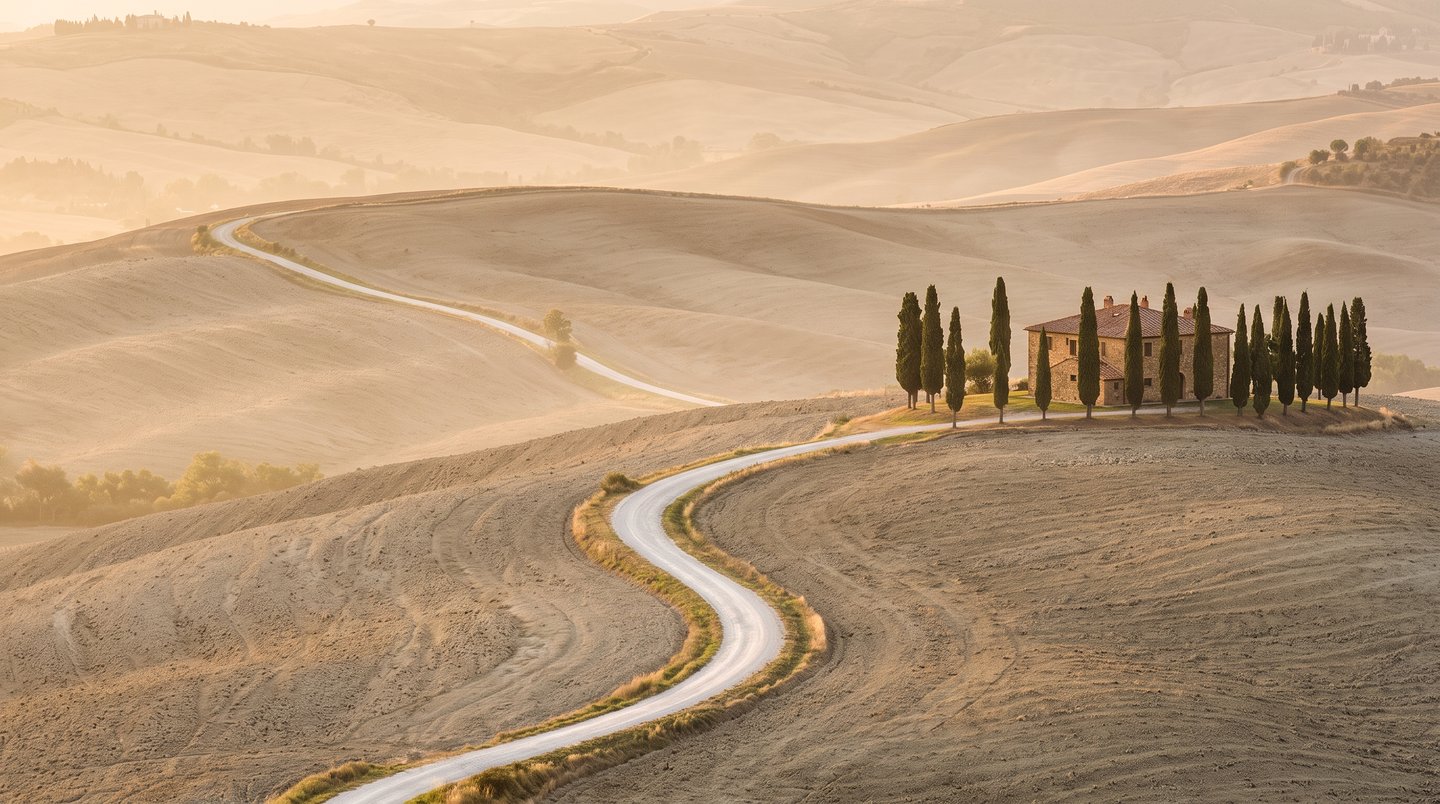
Most people see the Val d'Orcia for about eleven minutes. They pull over on the SP146 outside Pienza, photograph the farmhouse with the cypress avenue that everyone photographs, get back in the car and drive on to Montepulciano. It is a lovely eleven minutes. It is also very nearly the opposite of what this landscape is for.
The valley south of Siena is not a viewpoint. It is farmland that has been worked the same way for centuries, and it gives up almost nothing to people in a hurry. Stay four nights instead of four hours and it becomes a different place, one where the light matters more than the itinerary and where the best afternoon of the trip is usually the one with nothing scheduled in it.
What the Val d'Orcia Actually Is
This is a broad clay valley running roughly from San Quirico d'Orcia down towards Monte Amiata, with Pienza, Montalcino, Castiglione d'Orcia and Bagno Vignoni scattered around its edges. The famous bare hills are not natural. They are the result of medieval Sienese landowners clearing forest for grain, and the whole area was recognised as a UNESCO World Heritage cultural landscape in 2004 precisely because it is a working agricultural system rather than a preserved view.
That history explains why it looks the way it does. The wheat turns the hills green in April and gold in June, then they are ploughed back to bare brown clay by August, which surprises a lot of visitors who arrive in high summer expecting the postcard. Anyone reading about the valley's role as Siena's granary will understand the seasons better than anyone reading a travel brochure.
Go in May, or Go in October
The two good windows are late April to early June, and late September to the end of October. Spring gives you green hills, wildflowers and long evenings. Autumn gives you the olive harvest, truffles around San Giovanni d'Asso, Brunello cellars busy with the vintage and hotel rates that drop by a third once the school holidays end.
July and August are hot, dusty and crowded on the short stretch of road between Pienza and Montepulciano, and the fields are bare. Winter is quieter than most travellers expect, with fog sitting in the valley bottoms and a fair number of restaurants closed, though Bagno Vignoni in January is one of the more memorable things in Tuscany.
Base Yourself Badly and You Will Spend the Week Driving
The valley is small on a map and slow in practice. Roads wind, tractors appear, and the drive from San Quirico to Montalcino that looks like fifteen minutes takes closer to thirty five. Pick one base and accept that everything else is a day trip from it.
Pienza is the easy choice, central and walkable, though it fills with coaches between eleven and four. San Quirico d'Orcia is quieter and better placed for the southern half. Montalcino suits anyone whose trip is really about wine. If comfort is the priority over location, the wider comparison of the best hotels in Tuscany is worth reading before booking, because the valley itself has fewer rooms than people assume and the good ones go early.
The Things Worth Slowing Down For
Bagno Vignoni has a thermal pool in the middle of its main square, where a piazza would normally be. You cannot swim in it, but the terraces below the village have open air pools fed by the same spring, and an hour there at dusk in autumn is the single best cheap experience in the area.
Pienza is worth an early morning rather than a midday visit. It was rebuilt in the 1460s as a model Renaissance town by a pope who had been born there, and at half past seven the streets are empty and the pecorino shops are just opening. Montalcino and Sant'Antimo abbey pair well in one afternoon. The abbey is eleventh century, sits alone in an olive grove, and is quieter than almost any other church in Tuscany.
Eat Where the Menu Is Short
The food here is blunt and good. Pici, a thick hand rolled pasta, usually served with garlic and breadcrumbs or a wild boar ragu. Pecorino di Pienza in three ages. Beans, bread, olive oil, and not much else. A restaurant with eight main courses is a better sign than one with twenty five.
Speaking a little Italian changes the reception in these villages more than it does in Florence, where everyone switches to English by reflex. A handful of phrases is genuinely enough, and anyone who wants to prepare will find the practical advice on learning Italian as an English speaker more useful than an app streak. Ordering in Italian in a family trattoria in Castiglione d'Orcia gets you a different meal, and sometimes a different table.
The Case for Doing Less
Every Val d'Orcia itinerary you will find online packs five villages into a day. Do two. Sit somewhere between them for an hour with nothing to look at but the hills changing colour as the sun drops. That is the experience the photographs are trying and failing to capture, and it takes time rather than luck.
The valley rewards patience because it was built by patience. Six hundred years of people ploughing the same clay produced a landscape that now draws visitors from every continent, and the ones who leave saying it was overrated are almost always the ones who gave it an afternoon.